Although Japan is a small island country, its transportation network is one of the best in the world.
Most prefectures have airports, and domestic flights connecting large cities to rural areas are very convenient for transportation.
There are also many world-famous Shinkansen bullet trains, and you can reach most places by connecting the Shinkansen and local trains.
In addition, local buses such as high-speed buses connect various parts of Japan.
Aircraft
In Japan, there are 97 airports and airfields nationwide, excluding heliports.
There are 47 prefectures in Japan, but Tochigi prefecture, Gunma prefecture, Saitama prefecture, Kanagawa prefecture, Yamanashi prefecture, Gifu prefecture, Mie prefecture, Shiga prefecture, Kyoto prefecture, Nara prefecture, which are close to the capital Tokyo and the second city Osaka. There are airports in 37 prefectures other than the 10 prefectures.
Domestic flights operate from Tokyo International Airport (Haneda) in Tokyo and Osaka International Airport (Itami) in Osaka to various parts of Japan, as well as other major cities such as Sapporo in Hokkaido, Sendai in Miyagi Prefecture, and Nagoya in Aichi Prefecture. Domestic flights also operate from airports in Hiroshima and Fukuoka.
By the way, the following map shows the routes that operate from Tokyo International Airport (Haneda) to various places.
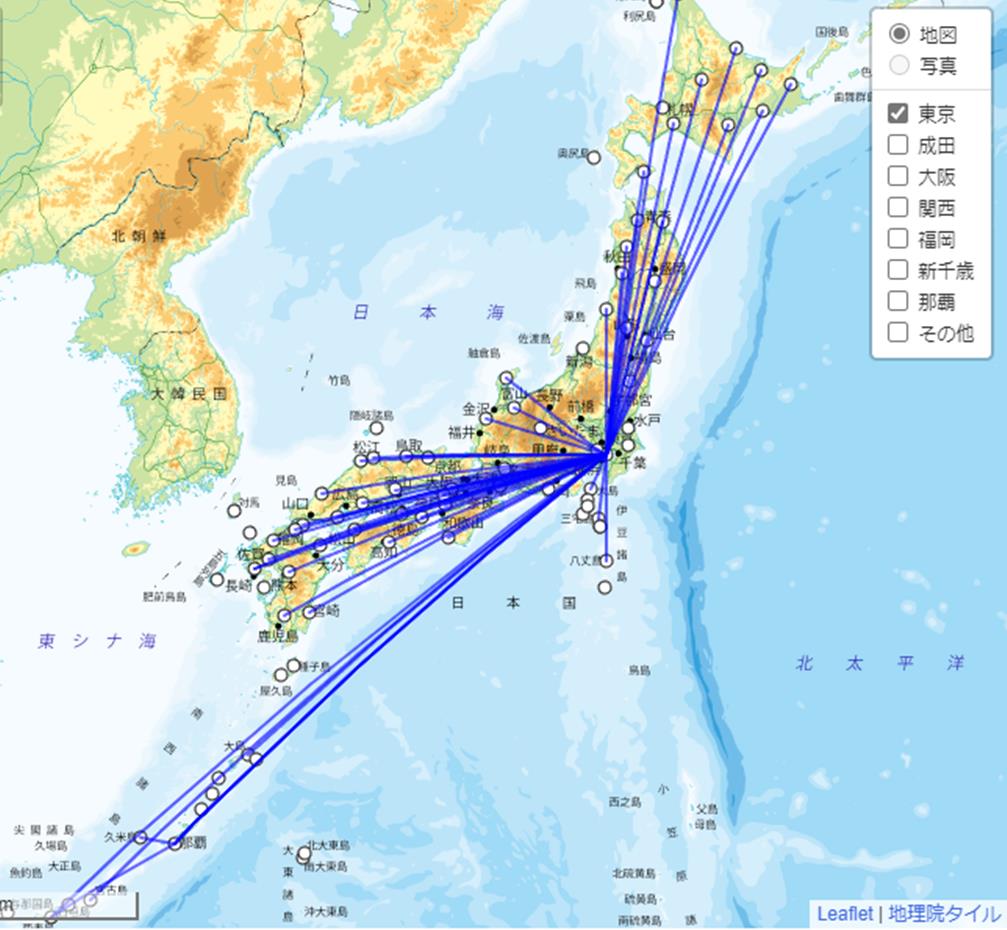
You can see that it covers almost all of Japan.
The advantage of an aircraft is that you can get to your destination faster.
The disadvantage is that it is expensive as a means of domestic transportation.
The number of low-cost carriers called LCC has also increased.
Japan Airlines (JAL) and All Nippon Airways (ANA), which also operate international flights, have a large number of domestic flights, but recently, the number of low-cost carriers called LCCs has increased.
Domestic LCCs include Jetstar Japan, Peach Aviation, Skymark, AIRDO, Solaseed Air, Star Flyer, Fuji Dream Airlines, etc., and depending on the season, you can board at a surprisingly low price.
Depending on the destination, it is also recommended to use LCC.
Bullet train
The Shinkansen is Japan's world-class high-speed railway.
In the history of the Shinkansen for more than 50 years, there have never been any fatal accidents such as passengers due to abnormalities in the facilities and equipment of vehicles and railroad tracks, inadequacy on the operation side, etc., and it is the safest high speed in the world. It is a railroad.
It is still under construction, but the routes are as follows.
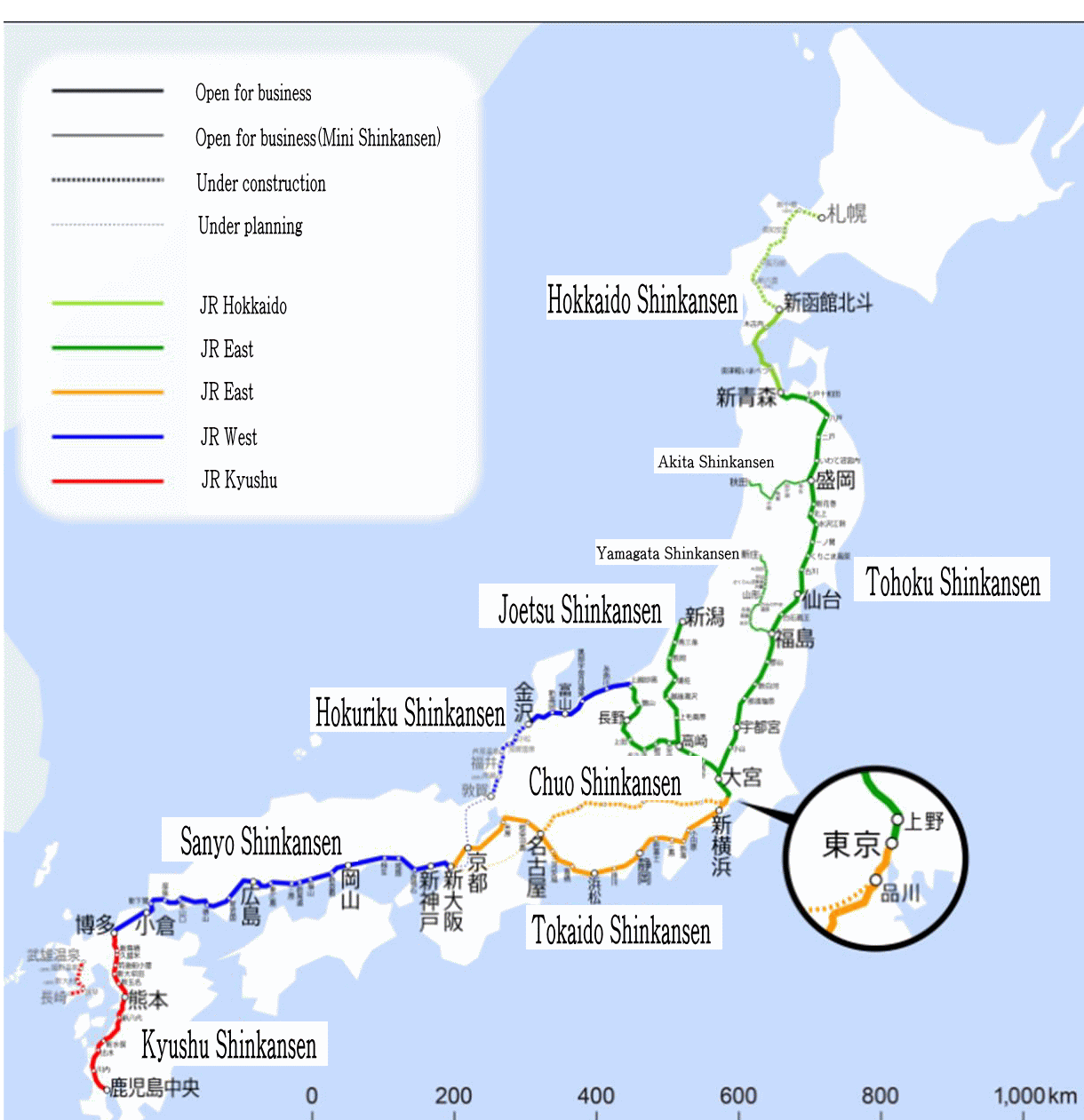
The practical line is currently in operation, and the thin solid line is the mini-shinkansen (a method that allows direct operation with the Shinkansen line after changing the existing conventional line without constructing a new Shinkansen standard line). It is a route.
Dotted lines are under construction or planned (thin dotted line).
Hokkaido is open only to Hakodate in the south, but to Kagoshima in Kyushu in the south.
The Shinkansen "Nozomi" operates between Tokyo and Osaka in a minimum of 2 hours and 20 minutes.
The advantage of the Shinkansen is that it has a large number of trains and operates accurately on time.
The disadvantage is that it is the second most expensive domestic means of transportation after an aircraft.
Conventional line
Railways other than the Shinkansen, so-called conventional lines, are also substantial.
Since the Shinkansen is a high-speed railway, the distance between stations is long, and there are only stations in large towns.
In that respect, conventional lines are very convenient because you can use railways spread all over Japan.
Due to the spread of the Shinkansen and the abolition of deficit routes, the number of conventional lines has decreased compared to before, but it is still active as a foothold for the Japanese people.
Although the number has decreased, sleeper trains are also in operation, and depending on the destination, you can move to your destination while sleeping at night.
The advantages of conventional lines are that you can go to destinations other than big towns and that fares are cheaper than airplanes and bullet trains.
The disadvantage is that it takes longer as a domestic means of transportation than airplanes and bullet trains.
Express bus
Japan has a lot of highways.
Highway buses are fixed-route buses that mainly travel on highways, and you can get to your destination cheaper than by plane or train.
The night coach, which operates late at night, allows you to reach destinations far away at low rates while you sleep.
Some highway buses are cramped due to the arrangement of seats (4 row seats are cheaper than the upper class with 3 or more rows of seats), but there are toilets etc., so people who want to move to their destination cheaply anyway It is perfect for.
The advantage of high-speed buses is that the fares are cheap.
The disadvantage is that it feels cramped because it is cheap.
Long-distance ferry
Japan is an island country.
Therefore, there are ports all over the country, and long-distance ferries are operated to various places in large cities.
Since it is a ferry, it is possible to board not only cars, motorcycles and bicycles, but also only people.
Since it is a cruise, it takes time, but it is cheap and comfortable to travel.
The main routes of long-distance ferries are as follows.
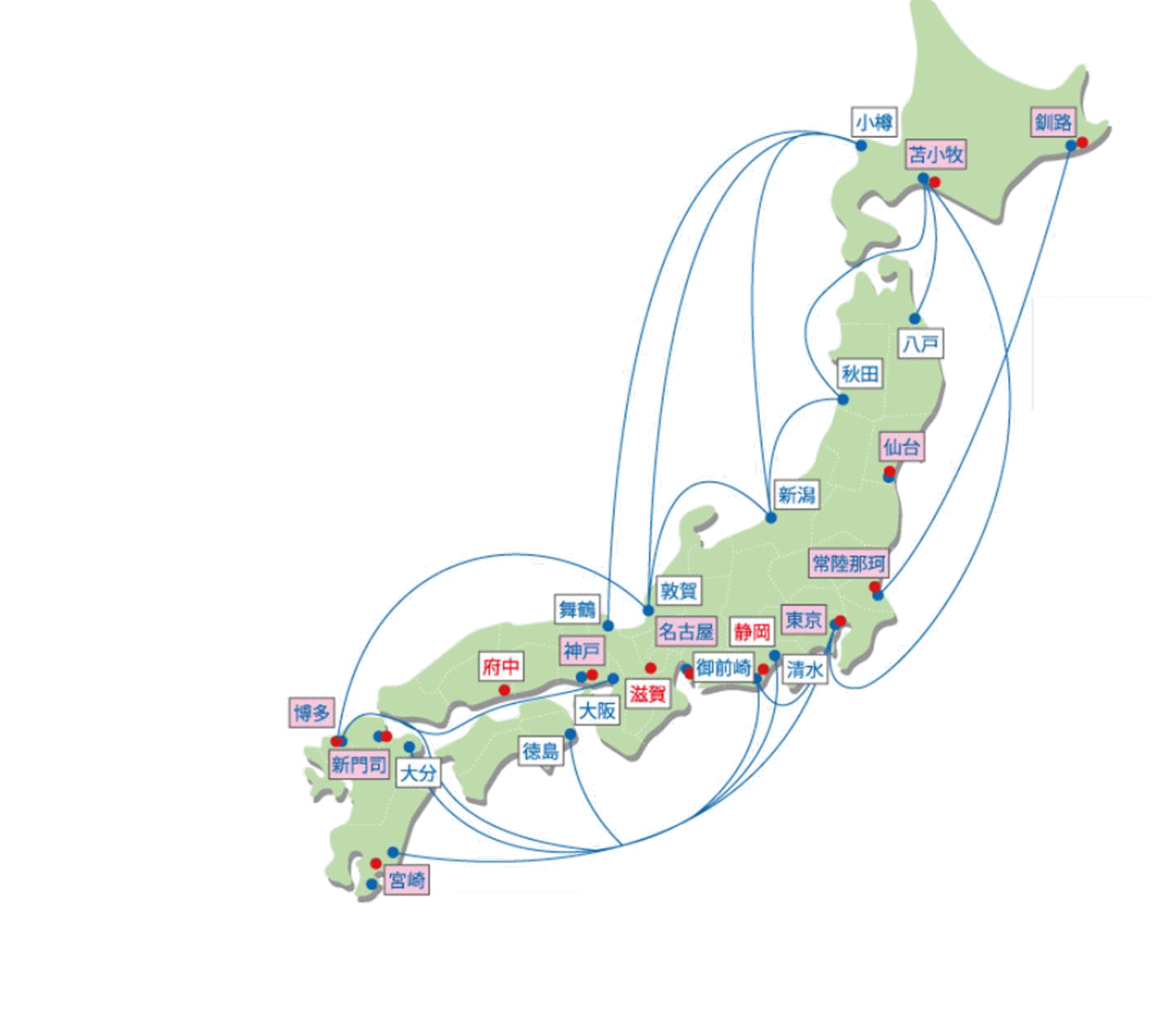
Long-distance ferries have limited routes, but they are an option if they suit your destination.
The advantage of long-distance ferries is that the fare is cheap and you can move comfortably.
The disadvantages are that it takes a long time to move and the route is limited.
Car rental
Recently, an increasing number of foreigners are using rental cars that allow them to move freely within Japan.
However, in order for a foreigner to drive a car in Japan, he / she must have one of the following licenses.
1. Japanese driver's license
2. International driving permit based on the Geneva Convention on Road Traffic (Geneva Convention)
3. Foreign driver's license for driving a car, etc. (A country that has not issued an international driver's license and has a license system that is recognized as being at the same level as Japan, and is currently in Switzerland, Germany, France / Belgium / Slovenia / Monaco / Taiwan only)
If you use a rental car, you can move freely within Japan without waiting.
If you use the highway or ferry, you can expand your range of activities.
However, you need to be careful.
Japanese cars drive on the left side.
For example, Hong Kong, Thailand, Singapore, etc. are the same countries with left-hand traffic as Japan, but they are rather minority, and from an international perspective, right-hand traffic is the mainstream.
Therefore, when a foreigner drives a rental car in Japan, it seems that it is easy for foreigners to have an accident in an unfamiliar environment different from their own country.
The driving sensation changes greatly just by changing the position of the steering wheel.
Also, due to the difference in signs, it is easy to overlook pauses and one-way streets.
When renting a car in Japan, please be sure to drive safely.
When renting a car, first apply online or at the shop window.
Just like when renting a car in your own country, decide on the date to rent, the date to return, the type of car, whether to drop off (one way), car navigation, ETC, etc. and apply.
You can apply at the rental car shop on the day you rent a car, but in that case you may not be able to rent the car you want.
It's a good idea to make a reservation a few days to a week in advance to rent a car.
When returning a Japanese rental car, fill up the gas at the gas station near the shop where you rented the car and submit the receipt to the shop.
The shop may specify the station to put gasoline in, so please check in advance.
If you drop off the car, you will have to return it at the affiliated store of the shop where you rented the car.
The return location will be specified in advance, so confirmation is required.
There are more than most access methods in Japan.
Japan is a small island country, but the transportation network within it is very substantial.
Please enjoy Japan with the means of transportation that suits your plan.