World heritage sites are buildings, archaeological sites, landscapes, and nature with "significant universal value" listed on the "World Heritage List" based on the World Heritage Convention adopted by the UNESCO General Assembly in 1972.
As of 2021, Japan has 5 natural heritage sites and 20 cultural heritage sites, for a total of 25 world heritage sites.
We will introduce it separately for natural heritage and cultural heritage.
How about using it as a reference when sightseeing in Japan?
Natural heritage
Yakushima (Kagoshima Prefecture)
Yakushima is a mountainous island with high peaks such as Mt. Miyanoura (1,936m), the highest peak in Kyushu, in the center. It is located below and is blessed with heavy rainfall of 4,000 to 10,000 mm per year, so it has extremely special forest vegetation, including Yakusugi, which is thousands of years old.
The vertical distribution of vegetation is remarkable, from subtropical plants such as banyan trees and oaks near the coast to temperate zones such as tabs, castanopsis and oaks, temperate zones such as fir and trochodendron, and subalpine zones such as yakuzasa and shakunage. Many endemic plants and northern and southern limit plants grow naturally, forming a unique ecosystem.
In particular, the outstanding natural feature of this area is the Yakusugi, which is said to be thousands of years old and has a diameter of 3 to 5 m. It is considered to be a valuable natural forest.
In addition, endangered animals and plants such as Ryukyu robin and Izu thrush (vulnerable species) inhabit and grow naturally in this area.
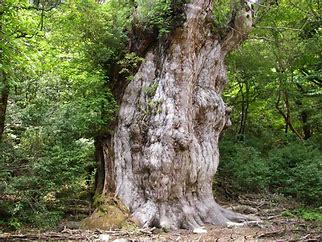 Jomon cedar on Yakushima
Shirakami Mountains (Aomori Prefecture, Akita Prefecture)
The Shirakami Mountains is a general term for a mountainous area of 1,300 km2 that stretches from the southwestern part of Aomori prefecture to the northwestern part of Akita prefecture, and has been the target of worship for the people of Tsugaru since ancient times.
About 170 ㎢, the center of this area, was registered as a World Heritage Site in 1993. The primeval forest, which weaves around beech, has not changed since the glacial period, and most of the flora and fauna here have been breathing with the beech forest for 8000 years.
Beech was once distributed all over Japan. Due to its high versatility as timber, logging has been repeated, and many are now planted forests. On the other hand, the beech forests in the Shirakami Mountains are far from human settlements and the terrain is steep, so they still exist in a state of primitiveness that is untouchable by humans.
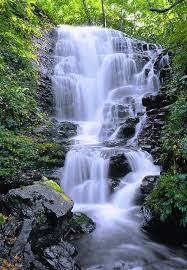
Clear stream in the Shirakami Mountains
Shiretoko (Hokkaido)
Shiretoko is a long and narrow peninsula in the northern part of Hokkaido, about 70 km long and about 25 km wide.
In the center of the Shiretoko Peninsula, the Shiretoko mountain range with an altitude of 1500 m, which was created by plates and volcanic activity, rises, the distance to the coastline is short, and cliffs continue on the sea side. Drift ice can be observed at the lowest latitudes in the Northern Hemisphere in the surrounding Sea of Okhotsk.
Protected by the harsh environment, the northern part of the Shiretoko Peninsula is a very rare area where precious nature and its ecological activities are still carried out. For these reasons, 71,000 ha including the Shiretoko National Park and its surroundings in the northern part of the Shiretoko Peninsula was registered as a World Heritage Site in July 2005.
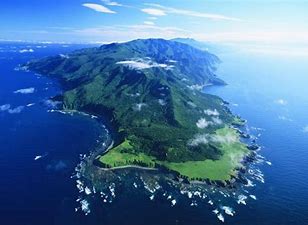
Shiretoko Peninsula
Ogasawara Islands (Tokyo)
The reason why the Ogasawara Islands have been registered as a World Natural Heritage site is because of their rich ecosystem.
In the first place, islands can be broadly classified into "continental islands" separated from the continent and "ocean islands" that have never been connected to the continent, but the Ogasawara Islands are the latter "ocean islands". It corresponds to.
In the Ogasawara Islands, which have never been connected to the continent since its birth, each organism has undergone its own evolution, and many "endemic species" that are unique in the world have been born.
For example, more than 90% of the snails living in the Ogasawara Islands, about 100 species, are endemic. In addition, many endemic plants and insects can be found in the Ogasawara Islands.
In this way, the Ogasawara Islands were registered as a World Natural Heritage Site in 2011 in recognition of their unique ecosystems that cannot be found anywhere else.
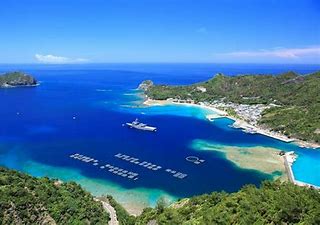
The sea of the Ogasawara Islands
Amami Oshima, Tokunoshima, Northern Okinawa Island and Iriomote Island (Kagoshima Prefecture / Okinawa Prefecture)
It is an area consisting of Amami Oshima and Tokunoshima in Kagoshima Prefecture, the northern part of the main island of Okinawa (Kunigami Village, Ogimi Village, Higashi Village) in Okinawa Prefecture, and Iriomote Island.
In the process of being isolated from the continent and repeating separation and coupling, a variety of uniquely evolved organisms such as Amaminokuro rabbit, Yanbarukuina, and Iriomote cat can be seen, and many of them are endangered rare species and biodiversity. It was decided to be registered as a natural heritage because it was evaluated as an important area for preserving sex.
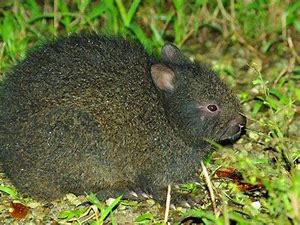
Amami rabbit
cultural heritage
Buddhist monuments in the Horyuji area (Nara prefecture)
Many of the oldest wooden buildings in the world remain in the Horyuji area.
Buddhist temples such as Horyuji Temple and Hokiji Temple were built in the 7th century, and religious activities are still ongoing at these temples.
Horyuji Temple was founded in the early 7th century, and the current temple is composed of Saiin, Toin and Koin.
Saiin was rebuilt from the latter half of the 7th century to the beginning of the 8th century, and Toin was built in the first half of the 8th century.
The main buildings of Saiin, the main hall, the five-storied pagoda, the central gate, and the corridor, are early Buddhist architectural styles that do not survive in China or Korea, and the other main buildings of both houses were built mainly in the 8th to 13th centuries. is. The children's houses around both houses began construction around the 12th century and gradually increased in number.
There are many buildings from the 17th century to the 18th century, and it can be said that it is an area where cultural heritage that can be seen the transition of Japanese Buddhist temple architecture is concentrated.
Hoki-ji is a temple built in the 7th century, but now only the three-storied pagoda completed in 706 remains, and like Horyuji Saiin, it is a building with an early Buddhist architectural style.
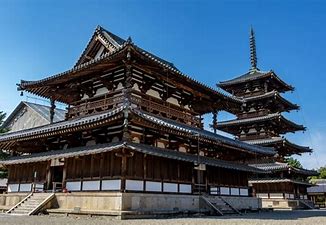
Horyuji Temple
Himeji Castle (Hyogo Prefecture)
The unique Japanese castle style of wooden buildings, stone walls and white walls was established in the middle of the 16th century.
Himeji Castle is a heritage of the heyday of this castle architecture and represents a Japanese castle in the early 17th century.
Among Japanese castles, the structure consisting of wooden castle buildings and walls / earth walls remains particularly well.
This castle is also known as Shirasagi Castle because of its elegant appearance with white walls.
Himeji is a transportation hub in western Japan, and Terumasa Ikeda, the lord of the castle in 1600, abolished the old castle in this area from the following year to 1609 and built a new castle.
The structures and buildings of Himeji Castle that remain today are those of this time, and are surrounded by a double moat inside and outside.
The main part of the castle fence and the residence of the castle owner were built in the inner moat surrounded by the inner moat and the high stone wall, and there was a samurai residence in the outer area between the inner moat and the outer moat.
Outside, there was a castle town consisting of residential and commercial areas for the general public, and there were moats around it.
The original appearance of the castle architecture in the inner area remains almost completely, and it is being preserved and maintained under the basic maintenance concept together with the outer area.
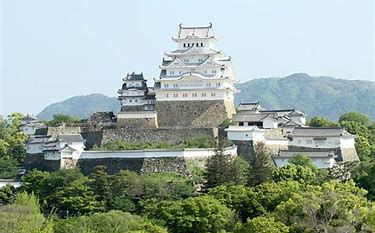
Himeji castle
Historic Monuments of Ancient Kyoto (Kyoto and Shiga prefectures)
Kyoto was the capital of Japan where the emperor lived from 794 to 1868, and prospered as a center of culture, economy, and politics except when the samurai government moved the center of politics to Kamakura and Edo.
Kyoto is a city built using the geographical feature of a basin surrounded by hills on three sides, north, west, and east.
In the central flat area, many fires struck and fires occurred frequently, and many buildings were lost and rebuilt.
However, the surrounding foothills have survived disasters, and there are still many large temples, mountain villas, and gardens built using the undulating natural terrain.
Even on the flat ground, large-scale monuments such as Toji Temple and Nijo Castle and cultural heritage such as townscapes showing various traditional residential styles remain in the Jobou system.
Toji Temple, which was built in the 8th century, is lined with buildings from each period from the 11th century to the 19th century, and Nijo Castle, which was built in the 16th century, retains the gorgeous buildings of that time on its vast grounds.
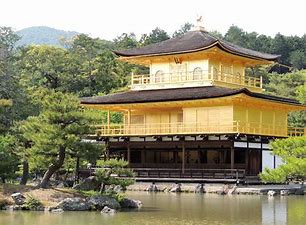
Kinkakuji Temple
Gassho-zukuri village in Shirakawa-go and Gokayama (Gifu and Toyama prefectures)
The village of Shirakawa-go consists of a large group of wooden houses.
Under the large thatched roof, there are 3 to 5 floors, the 1st floor is a large living room, and the 2nd and higher floors are attic bedrooms or work spaces.
It was common for a large family of dozens to live in one building.
The Ogimachi area, where about 50 private houses of this type in the 18th and 19th centuries remain, is located in a mountainous field, surrounded by broad-leaved forests, and the private houses are built parallel to the direction of the central valley. Together with the steep thatched roof, it constitutes a unique village landscape.
Shirakawa-go is located in the mountainous area in the center of Honshu.
Since the end of the 17th century, this area has been under the direct control of the Edo Shogunate, and many of the inhabitants lived in the cutting and carrying out of forest trees and sericulture in addition to farming.
In the attic of the private house, sericulture work was also done.
It is also interesting that there is a mutual aid organization for residents called "Yui", and the custom of jointly maintaining the house, such as changing the roof, remains.
The Shirakawa village, which has a large space for living and working and is lined with private houses where large families lived, has a unique landscape in the world.
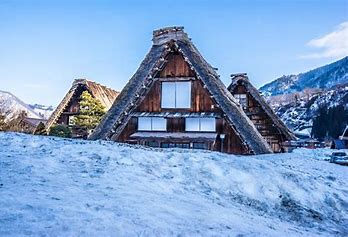
Gassho-zukuri village in Shirakawa-go and Gokayama
Atomic Bomb Dome (Hiroshima)
The Atomic Bomb Dome is a Hiroshima Prefectural Product Exhibition Hall built in April 1918 with the aim of improving and promoting Hiroshima Prefecture's products and contributing to the development of industry. It was designed by Czech architect Jan Letzel. .. On the delta formed by the Ota River that flows from the northern Chinese mountains to Hiroshima Bay, the junction of the Ota River (main river) and the Motoyasu River was selected as the construction site, and about 2,310 square meters of that riverbank was reclaimed from the former Hiroshima clan. It is said that Yonekura and private land were prepared and added, and a total of about 3,200 square meters was used as the site.
The building was a three-story building made of brick and reinforced concrete, with the front central staircase as a five-story dome and partly having a basement.
The dome part of the roof was thatched with copper plate, and the others were slate thatched. The height to the tip of the dome was about 25 meters, and the building area was about 1,002 square meters.
There was also a Western-style garden with a fountain pond and a Japanese-style garden with Azumaya.
The building is located at a close distance of about 160 meters northwest of the hypocenter of the atomic bomb, and was wrecked and burned down by the heat rays and blast.
However, it is believed that the center of the dome miraculously escaped collapse because the blast worked almost vertically from above (explosion point altitude of about 580 meters).
The name "Atomic Bomb Dome" is said to have been "naturally spoken by the citizens without anyone" from the appearance of the wreckage of the canopy on the top of the building in the shape of an umbrella. ..

Atomic bomb dome
Itsukushima Shrine (Hiroshima Prefecture)
Itsukushima Shrine is a rare shrine in Japan where wooden buildings are lined up in the sea of the cove with the island of the Seto Inland Sea in the background.
The structure of the shrine began in the 12th century, but it was burnt down and rebuilt in 1241. Despite being in a harsh environment as a wooden building built on the sea, it conveys the old style to this day, supported by the strong asylum of successive administrations.
Itsukushima behind the shrine is an island of about 30 square kilometers and is designated as a special historic site and a special scenic spot.
Since ancient times, the main peak of Mt. Misen (530m above sea level) has been the object of reverence, and the entire island has been sacred.
It is thought that this is the reason why the shrine was built here.
In addition, the beautiful natural landscape of Itsukushima's lush forests approaching the coastline has been praised as one of the "three most scenic spots in Japan" since the 17th century.
Itsukushima Shrine, which has a unique structure, is lined up toward the sea in such a natural landscape.
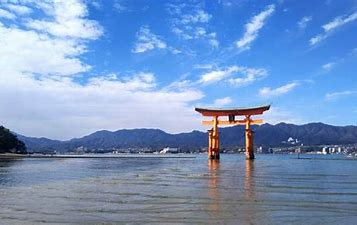
Itsukushima shrine
Cultural property of ancient city Nara (Nara Prefecture)
Nara was the capital of Japan from 710 to 784 and prospered as a center of politics, economy and culture.
During this period, the prototype of Japanese culture was formed through exchanges with China (Tang).
Even after the capital moved to Kyoto, the area centered on the shrines and temples continued to prosper as a religious city.
These cultural heritage sites include palace ruins, temples, and shrines.
Heijo Palace is the residence of the emperor in the northern center of the capital, and is attached to the facilities of the administrative agency.
The remains of wooden buildings such as palaces and government offices at that time are still well preserved underground.
Many shrines and temples built in and around the capital still carry the lanterns, and the buildings of each era, including the 8th century Dou, remain.
At Yakushi-ji and Toshodai-ji, ancient Japanese buildings from the 8th century remain, and these are representative of the Buddhist temples of the time.
The main part of Todaiji Temple and Kofukuji Temple was lost due to the fire, but some of the 8th century buildings remain in the vast precincts.
Much of what was lost was revived in the 12th century. At the time of revival, new Chinese building technology at that time was introduced, and the representative building is Todaiji Nandaimon.
The Kondo of Todaiji Temple, which was rebuilt in the 8th century, is the largest wooden building in the world.
The Kasuga Taisha building was mainly reconstructed in the middle of the 19th century, and has been rebuilt every 20 years according to the tradition of a full-fledged Japanese shrine, which conveys the traditional style to this day.
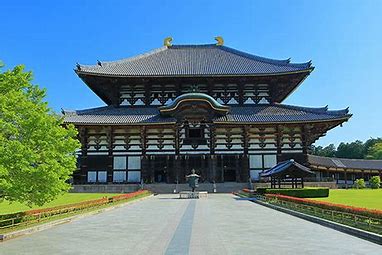
Todaiji Temple
Shrines and Temples of Nikko (Tochigi Prefecture)
Nikko has been a sacred place for the Tokugawa Shogunate since the Toshogu Shrine, the mausoleum of the first Tokugawa Shogun Ieyasu, was built in 1616.
After that, Toshogu was completely rebuilt in 1636 and became the current scale and structure.
Furthermore, in 1653, Taiyu-in Temple, the mausoleum of the third shogun Iemitsu, was built.
Since the 8th century, Nikko has been a sacred place for mountain worship centered on Mt. Nantai, and shrines and temples have been running at the foot of the mountain and on the shores of Lake Chuzenji.
At the eastern foot of Mt. Nantai, where Toshogu was built, there were Rinnoji Temple and Futarasan Shrine, which were built on a large scale.
The building, which was built by the Shogunate with all its might, uses a lot of sculptures of people, animals, plants, etc., and is brilliantly decorated with lacquer, coloring, and decorative metal fittings.
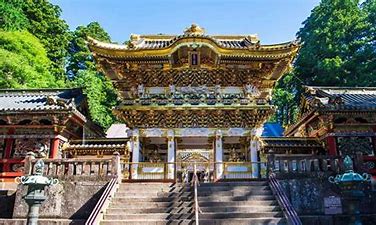
Nikko Toshogu
Gusuku Sites and Related Heritage Sites in the Kingdom of Ryukyu (Okinawa Prefecture)
The Ryukyu Islands are located at the southern tip of the Japanese archipelago. The three kingdoms were separated in the middle of the 14th century, but in the first half of the 15th century, the Ryukyu Kingdom was established by unifying them.
Based on wide-area trade with China, Korea, Japan, and Southeast Asian countries, a unique culture with a rich international flavor that was different from the Japanese culture at that time was formed.
Gusuku is a cultural heritage that clearly reflects its characteristics.
Nakijin Castle, Zakimi Castle, Katsuren Castle, and Nakagusuku Castle were all built from the beginning of the Three Kingdoms period to the establishment of the Ryukyu Kingdom. It is a thing.
These walls are mainly constructed of coral limestone, and have the unique characteristics of Ryukyu that make heavy use of curved surfaces.
In addition, the remains of Enkakuji Temple, Tamaudun, and Shikina-en (villa) remain as royal ruins, and you can see the kingdom culture.
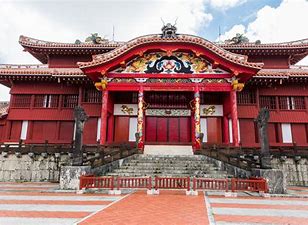
Shuri Castle
Sacred Sites and Pilgrimage Routes in the Kii Mountain Range (Mie Prefecture, Nara Prefecture, Wakayama Prefecture)
The Kii Mountains are located on the Kii Peninsula, which overhangs the Pacific Ocean at the southernmost tip of Honshu.
The Kii Mountains have nurtured the spirit of nature worship since ancient times, and since the introduction of Buddhism in the 6th century, the Kii Mountains have become a place for mountain training, including Shingon Esoteric Buddhism.
Among them, Shugendo, which was established in the mid-10th century to the 11th century with the aim of acquiring supernatural abilities through mountain training, was especially focused on the mountainous areas of the Omine Mountains.
It was also worshiped as a sacred place for the "Shinbutsu Shugo" idea that was widely disseminated in the 9th and 10th centuries. ..
Furthermore, in Japan around the 10th to 11th centuries, "Mappo thought" (the idea that Buddhism declines and the world ends) became popular, and after death, it was called "Jodo sect", hoping that he would go to Sukhavati Jodo, the residence of Amida Buddha. Buddhist teachings spread among aristocrats and the common people.
Along with this, it became believed that the Kii Mountains, which stretches to the south of the city, had the Pure Land of Buddhist priests, and the nature of this area as a sacred place became even stronger.
The background to the importance of the sacredness of this region was largely influenced by the unique terrain of deep mountains approaching the southern sea and the contrasting landscape composition of the two. Is being considered.
Against the background of various forms of worship rooted in the natural environment such as the unique topography, climate, and vegetation, there are three prominent sacred sites called "Yoshino / Omine," "Kumano Sanzan," and "Koyasan." A "pilgrimage route" was formed to connect them.
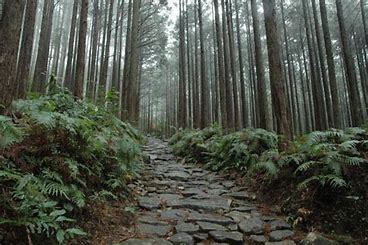
Kumano Kodo
Iwami Ginzan Ruins and its Cultural Landscape (Shimane Prefecture)
The Iwami Ginzan Site is located in the center of Shimane Prefecture facing the Sea of Japan, and represents the entire mine development from mining and refining of Iwami silver to transportation and shipping. , And the "road" that connects them.
This archaeological site is a proof of cultural and civilization exchanges in the east and west world, and has value as a cultural landscape that represents the total land use related to archaeological sites and silver mines that prove silver production by traditional techniques. increase.
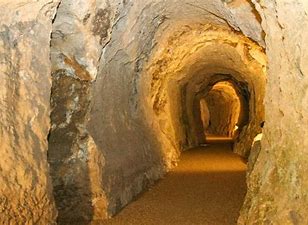
Iwami Ginzan Mine
Hiraizumi-Architecture / Garden and Archaeological Sites Representing French Land (Jodo) (Iwate Prefecture)
Hiraizumi is a political and administrative base built with the aim of realizing an ideal world based on Buddhism in the northern region of the Japanese archipelago in the 11th and 12th centuries.
The four gardens that exist at that base are materialized by Mr. Fujiwara Oshu by carefully arranging the Buddhist temples in relation to the symbolic expression of the land of Buddha (Pure Land) in this world, that is, the pond, the forest, and the summit of Kindori. It was built as a scene of the ideal town.
Three of the four gardens focus on the sacred mountain of Mt. Kindori, exemplifying the fusion of the ideal of the Pure Land Buddhism with the ancient Japanese concept of the connection between gardens, water and surrounding landscapes. I am.
Two of the Pure Land Gardens have been restored based on many details found in the excavation, and the other two are still buried underground.
In addition, the Buddhist temple of Chusonji, which is heavily covered with gold leaf, is the only one that has survived since the 12th century and reflects the huge wealth of Mr. Fujiwara Oshu.
The complex of four temples and Buddhist temples, which existed in this once huge political and administrative base, with a Pure Land Garden, a prominent Buddhist temple that has survived since the 12th century, and a relationship with the sacred Kinkeizan, reflects Hiraizumi's financial strength. It is a rare gathering, and represents the concept of planning and garden design that influenced Buddhist temples and gardens in other cities in Japan.

Chusonji
Mt. Fuji-The object of worship and the source of art (Yamanashi and Shizuoka prefectures)
Mt. Fuji is a conical stratovolcano with an extremely beautiful mountain range at an altitude of 3,776 m. The southern foot of the volcano extends to the beach of Suruga Bay, and the actual height of the mountain body from the sea surface is one of the highest in the world.
Since it has repeatedly erupted since ancient times, it has been revered by many people as a sacred mountain and has been popular as a "famous mountain" that represents and symbolizes Japan.
The shrine was built at the foot of the mountain, and later the Fujisan Hongu Sengen Taisha Shrine and the Kitaguchi Hongu Sengen Shrine were established.
From the Heian period to the Middle Ages, it prospered as a dojo for Shugendo, but in the early modern period, Fujiko was organized in Edo and its suburbs, and many people carried out large-scale worship activities for the purpose of Fuji Zen meditation.
This mountaineering style based on the belief of the mountain people peculiar to Japan still keeps its lifeline, and it is a feature of Mt. Fuji with many climbers who visit especially in the summer.
In addition to being depicted in many paintings such as "Ippen Shonin" and "Thirty-six Views of Tomitake" by Katsushika Hokusai, many waka poems about Mt. Fuji in "Manyoshu" and "Kokonwakashu". Is left.
In this way, Mt. Fuji is world-famous as a "famous mountain" that forms the basis of a country's culture, and is not only a beautiful stratovolcano that boasts the highest peak in Japan, but also as an object of worship and a source of art. In addition, it was evaluated as having outstanding universal value because it has global significance as a cultural landscape related to various literary activities.
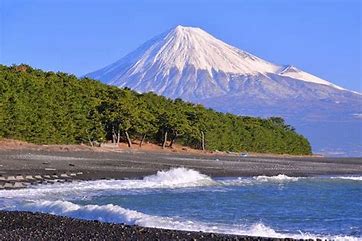
Mount Fuji
Tomioka Silk Mill and Silk Industry Heritage Group (Gunma Prefecture)
The Tomioka Silk Mill and the silk industry heritage group are an aggregate showing technological exchanges and technological innovations that contributed to the realization of mass production of high-quality raw silk from the latter half of the 19th century to the 20th century, when integration through trade in the world economy progressed. is.
The result is the development of the global silk industry and the popularization of silk consumption.
This technological innovation was achieved by combining both the innovation of silk reeling technology and the innovation of sericulture technology that supported the increase in production of high-quality cocoons, which are the raw materials.
This asset combines the components that show the process of technological innovation in silk reeling and sericulture that supports it, and is a prominent example that conveys the entire process of producing raw silk to this day.
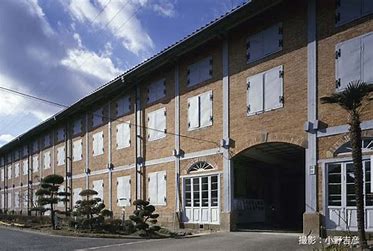
Tomioka Thread Mill
Meiji Japan's Industrial Revolutionary Heritage Steelmaking / Steelmaking, Shipbuilding, Coal Industry (Fukuoka / Saga / Nagasaki / Kumamoto / Kagoshima / Yamaguchi / Iwate / Shizuoka)
"Meiji Japan's Industrial Revolutionary Heritage: Iron and Steel, Shipbuilding, Coal Industry" is composed of a group of industrial heritage that testifies to the successful transfer of industrialization from the West to the non-West.
From the latter half of the 19th century to the beginning of the 20th century, Japan laid the foundation for an industrialized nation and achieved rapid industrialization in shipbuilding, steelmaking / steelmaking, coal and heavy industry, which later became Japan's core industries.
A series of heritage groups will take the path to the formation of an industrial nation in the fields of shipbuilding, steelmaking / steelmaking, coal and heavy industry, where Western technology was transferred in the half century from the 1850s to 1910, and through practice and application, it was constructed as an industrial system. I testify in chronological order.
Le Corbusier's Architectural Works-A Significant Contribution to the Modern Architecture Movement (Tokyo)
Consists of 17 assets located in 7 countries (France, Japan, Germany, Switzerland, Belgium, Argentina, India) selected from the works of Paris-based architect and city planner Le Corbusier Will be done.
This asset is the first evidence in the history of architecture that the practice of architecture has become global, and each constituent asset is wide, reflecting the new concept of architecture that meets modern social and human needs. It has had a significant impact on the region and is still the foundation of 21st century architectural culture.
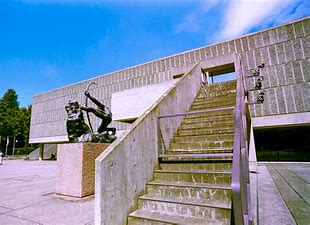
National Museum of Western Art
"Kamijuku Island" sect statue, Okinoshima and related heritage groups (Fukuoka Prefecture)
"'Kamijuku Island' Munakata / Okinoshima and related heritage groups" is a cultural tradition that worships "Kamijuku Island" Okinoshima, which developed during the period of active foreign exchange in ancient East Asia, and provided maritime safety. It is a rare evidence that is clearly associated with the desired living tradition and has been passed down to this day.
On Okinoshima, archaeological sites showing the transition of ancient rituals between the 4th and 9th centuries have been left almost untouched until the present day.
Okitsu-miya, Nakatsu-miya, and Hetsu-miya, including the ruins of ancient rituals, continue to this day as places of worship called Munakata Taisha.
The assets that tell the existence of Munakata, who carried and nurtured that belief, are the Niihara and Nuyama burial mounds.
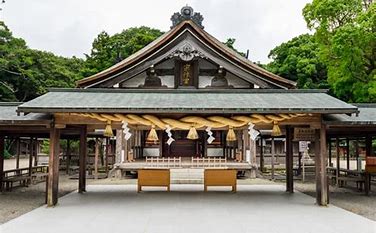
Munakata Shrine
Hidden Christian Sites in Nagasaki and Amakusa Region (Nagasaki and Kumamoto Prefectures)
This asset is a rare evidence of the tradition of "hidden Christians" who secretly continued their faith while coexisting with existing societies and religions in Nagasaki and the Amakusa region during the persecution of Christianity.
The ruins of Hara Castle, where the events that triggered the formation of the cultural tradition of the hidden Christians have been clarified archaeologically, the hidden Christians secretly coexisted with other religions in various forms in order to maintain their faith. Villages (Sacred sites and villages of Hirado, Sakizu village of Amakusa, Izu village of the open sea, Ono village of the open sea), villages of remote islands that moved to maintain the religious organization (village of Kuroshima, village of Nozakijima) The ruins, the village of Kashiragashima, the village of Hisakajima, the village of Egami on Narushima (Egami Catholic Church and its surroundings), and the event that triggered the end of the tradition of hidden Christians, and were involved with the hidden Christian villages in various places. It is composed of the Oura Catholic Church.
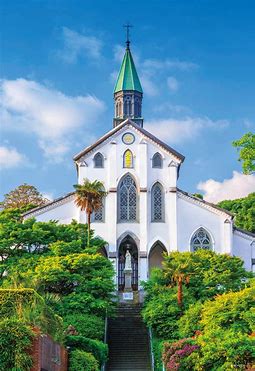
Oura Catholic Church
Mozu-Furuichi Kofungun-Ancient Japanese Tombs (Osaka)
From the latter half of the 4th century to the latter half of the 5th century, when the Kofun period was at its peak, the Mozu-Furuichi Kofun Group was located in Osaka Bay, which was one of the political and cultural centers of the time and the departure and arrival point of the route to the continent. It was built on the plain that touches it.
It is composed of ancient burial mounds that show a variety of sizes and shapes, from front-rear burial mounds that reach nearly 500 meters in length to burial mounds in the 20-meter range, which are unique in the world.
The burial mound is the stage for funeral ceremonies, geometrically designed, and decorated with haniwa and other exteriors.
This asset represents a unique technical achievement of earthen structures and is a prominent proof of the history of the people of the Japanese archipelago, who symbolized power through tombs.
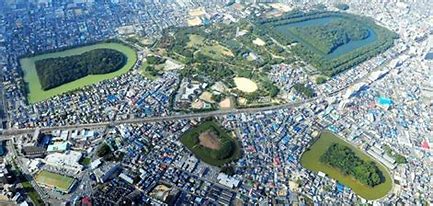
Hyakutobori / Furuichi Kofungun
Jomon Sites in Hokkaido / North Tohoku (Hokkaido / Aomori / Iwate / Akita)
The "Hokkaido / Northeastern Jomon Sites" is a cultural heritage that conveys the lives and spiritual culture of people who have settled by collecting, fishing, and hunting for over 10,000 years.
It consists of 17 archaeological sites located in Hokkaido, Aomori, Iwate, and Akita prefectures.
Hokkaido and the northeastern part of Hokkaido, where this asset is located, have a variety of terrain such as mountains, hills, flatlands, and lowlands, and inner bays, lakes, and rivers with abundant water are also formed.
The forest of cold temperate deciduous broad-leaved trees (northern beech zone) composed of beech, quercus crispula, chestnut, walnut, etc. spreads, and in the ocean, the intersection of warm and cold currents creates a rich fishing ground, and migratory fish such as salmon and trout. Was in a blessed environment even in Northeast Asia, such as the run-up.
People manage and use the forest resources cultivated in this environment, secure food in a stable manner, and start settling using earthenware from about 15,000 years ago based on collection, fishing, and hunting. Did.
After that, the settlement was formed, developed, and matured while skillfully responding to climate change and the resulting changes in the sea level such as sea level rise and fall and volcanic eruptions. This asset can fully explain the transition process with physical evidence.
Furthermore, by constructing and developing ritual spaces and structures such as graveyards, stone circles, shell mounds, and embankment remains, a unique spiritual culture that can be seen in clay figurines that are said to express motherhood is cultivated, and mature settlement is achieved. I ran.
In this way, this asset has outstanding universal value as evidence of pre-farming human life and elaborate and complex spiritual culture in Northeast Asia.
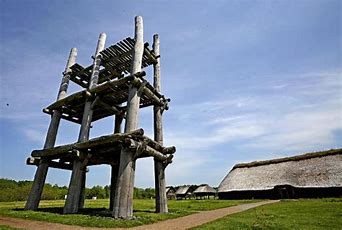
Jomon Sites in the northeastern part of Hokkaido